Milestone 6: the frame on Apple silicon

Twenty seconds into the opening on my M3 Max. The fully lit scene, measured later in the sequence, runs at 84 frames a second at 1920 × 1080.
Milestone 5 redesigned the frame for my RTX 3090 Ti and took it from 89 to 174 frames a second. The M3 Max was still running Milestone 4 ’s design, nothing arranged for Apple’s hardware: 57 frames a second at 1920 × 1080 and 16 at the laptop’s own 3456 × 2234. This milestone asked the Mac the question the last one asked the 3090.
What the profile showed
The denoiser was 43% of the frame at the larger size, its convolutions running entirely in 32-bit arithmetic at about a quarter of the occupancy the GPU aims for. Every pass that traces rays kept the M3’s ray-tracing unit 75 to 97% busy. Finding the first surface that isn’t glass or a mirror took 8.1 ms, almost as long as the whole path tree; on the 3090 it takes 0.74.
Rather than pick fixes one at a time, I took the production designs that already run on this hardware and built them whole: Blender Cycles’ Metal backend for tracing, Apple’s guidance for its GPU, and Intel’s Open Image Denoise for running a U-Net on Metal.
The same change, the other result
Moving every sphere to fine triangle meshes made the 3090’s frame 10% cheaper. On the M3, following Cycles, it slowed every reuse pass by 16 to 29%, and Apple’s advice to merge overlapping instances, which a pile of marbles is, slowed it again. Cycles’ way of seeding MNEE cost 3.3 ms on the marbles, so I went back to the 3090’s single traversal of the glass’s bounding boxes.
Apple’s hybrid design rasterizes what the camera sees and traces only where glass or a mirror sends the ray on. My first version was slower than the rays it replaced, because the rasterizer drew all 12.6 million of the fireflies’ triangles twice a frame. Drawing each firefly at the coarsest mesh within a thirtieth of a pixel, as raster engines do, fixed that. The network moved onto Apple’s own kernels in 16-bit, which was only a little faster than mine: 5.73 ms against 6.23.
Those three changes took the frame from 57 to 60 frames a second, and the 3090’s scheduling and memory-layout work took it to 63. Every step was production practice, and on this machine most were worth a few percent.
Apple’s denoiser
MetalFX Denoising is Apple’s own trained denoiser and upscaler. In the frame it ran faster than my network, 77 frames a second against 63, and lost what the scene is built around:
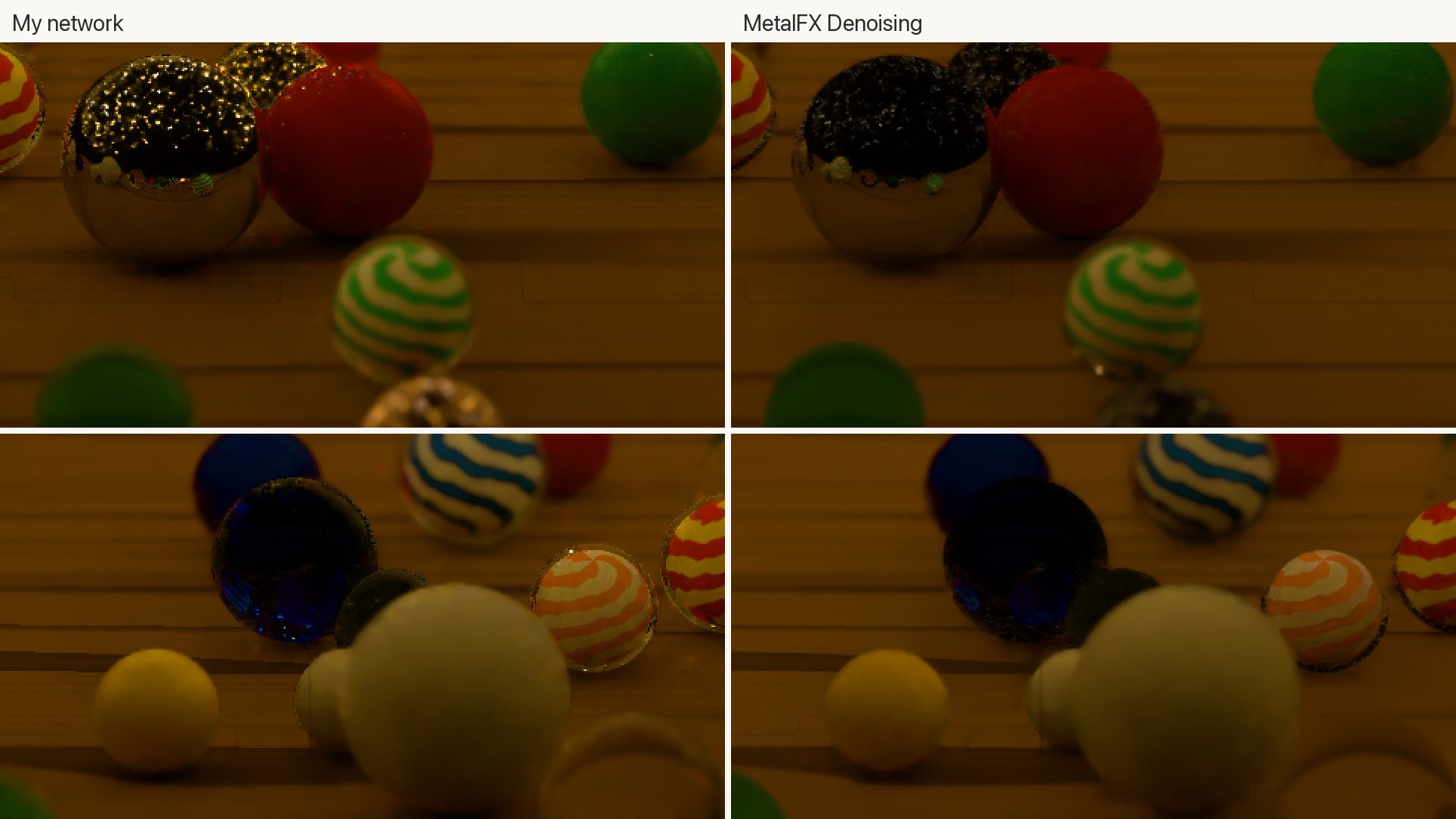
The same frame, two crops. MetalFX loses the fireflies’ pinpoints in the mirrored marble and most of the light inside the blue glass.
I kept my network.
A second accelerator
The M3 Max also has a 16-core Neural Engine the frame never used. Apple’s guidance for rendering runs networks on the GPU, and I found the Neural Engine only in shipping video upscalers, not renderers, so this was my call rather than production’s.
On its own the Neural Engine runs this network slower than the GPU, 6.46 ms against 5.97. What changes is that those milliseconds stop belonging to the GPU:

The input sits in memory both units read, so nothing is copied. The Neural Engine does need its shapes fixed in advance (a flexible model ran five times slower), so the model carries 121 sizes and the frame pads up to the next one.
The frame went from 63 to 84 frames a second at 1920 × 1080, and from 18 to 25 at 3456 × 2234. Only 0.3% of pixels differ from the GPU’s result, by at most two levels of 255.
This is the inference question that brought me to Serenity in its plainest form: which unit on the chip should run the network, and what does the hand-off cost. Here the round trip is about 0.6 ms more than the network alone, and moving it off the GPU took a quarter off the frame’s time.
Where it stands

Measured on the fully lit scene with the GPU otherwise idle. The first three changes were measured individually on a busy machine, so they are shown together.
Tracing the light now takes 11.27 ms of the 11.89 ms frame, most of it in passes bound by the ray-tracing unit. A third frame in flight would recover at most the half millisecond between light halves. I’m calling this the limit for this frame on the M3 Max’s ray tracing; the one production design left untried here is Cycles’ wavefront integrator, which lost on the 3090. The design notes , Neural Engine measurements and MetalFX comparison keep the experiments, including the changes I dropped.
Next is AMD’s Strix Halo through HIP and HIPRT, a third design for the same frame.
Milestone 4 beside Milestone 6
The frame rates in the labels were measured on the fully lit scene about two minutes in, both on the same M3 Max. This film shows the opening.